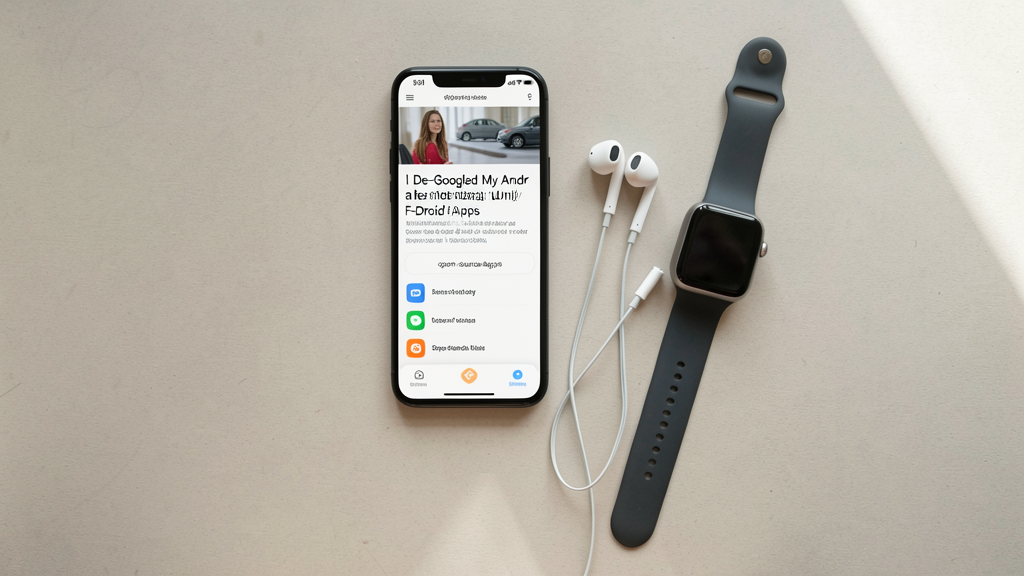
I De-Googled My Android Phone for a Week Using Only F-Droid Apps
A detailed narrative of seven days without Google services, replacing Maps, Drive, and Chrome with functional FOSS alternatives from F-Droid.

On Monday, June 1st, 2026, I performed a digital lobotomy on my daily driver. I wiped the Google Play Services framework, logged out of my account, and disabled the proprietary binaries that keep the modern Android ecosystem humming. My goal was not merely to test apps, but to survive a full work week using exclusively software from F-Droid, the community repository for Free and Open Source Software (FOSS).
The challenge focused on the "Big Three" dependencies: Maps for navigation, Drive for file handling, and Chrome for web access. I needed to prove that a phone could remain a functional tool for a professional editor without feeding data to Mountain View.
The experiment began with the installation of the client itself. Since I no longer had access to the Play Store to download the official F-Droid APK, I had to sideload the initial package via the web interface. For those unfamiliar with the setup process for F-Droid, it requires enabling "Install from Unknown Sources" a security setting that sends shivers down the spine of any cautious user. Once the repository was added, the digital storefront looked sparse compared to the glossy aisles of the Play Store, but the utility was immediately apparent.
Finding My Way Without Satellites
The first hurdle appeared on Tuesday morning. I had a meeting across town at a client's office I had never visited. Usually, I would tap a blue pin and let Google's algorithm guide me. Instead, I opened Organic Maps. This app relies on OpenStreetMap (OSM) data, and I had pre-loaded the vector map for my entire metropolitan area (a 450MB download) over Wi-Fi the night before.
The interface felt utilitarian, almost reminiscent of GPS units from the early 2010s. There were no reviews of coffee shops, no busy hour indicators, and no integration with ride-sharing apps. I punched in the address. The route calculation took roughly three seconds longer than I was accustomed to.
Driving was the real test. Google Maps excels at rerouting based on real-time traffic analysis. Organic Maps does not track traffic in the same way; it relies on passive data. As I hit a gridlock on the highway, the app kept directing me into the jam, oblivious to the standstill. I had to rely on my own eyes to spot an exit ramp. I arrived at my destination four minutes late, but the turn-by-turn voice instructions were clear, and the app did not crash once. The trade-off was stark: I gained absolute location privacy, but I lost the predictive convenience that makes city driving tolerable.
Severing the Cloud Tether
Wednesday brought the file management crisis. My editor sent me a 200MB video file for a project via Google Drive. Without the official Drive app, notifications were non-existent. I had to access the link through a browser, but the mobile web interface for Drive is notoriously aggressive about forcing the app download.
I switched my strategy to Syncthing, a continuous file synchronization program available on F-Droid. I set up Syncthing on my laptop and paired it with my phone using a series of QR codes. The folder structure mirrored instantly. The difference between Google Drive and Syncthing is the philosophy of ownership. Google stores data on their servers; Syncthing creates a peer-to-peer mesh network between my devices.
Transferring the 200MB video took approximately 12 minutes over my home Wi-Fi, a process that likely would have been faster via a cloud server. However, once synced, the file lived natively on my storage. I could edit it, move it, and view it without a data connection. The friction here was high—I had to convince my collaborator to use a different transfer method for future files—but the satisfaction of owning my data pipeline was immense. I was no longer renting space on a server I couldn't audit.
Browsing Without the Tracking Pixel
By Thursday, the absence of Chrome was noticeable. I realized how ingrained Google account synchronization is for passwords and autocomplete. I installed Fennec F-Droid, the reproducible build of Firefox maintained by the F-Droid team.
Many users ask why use Fennec F-Droid instead of the official Firefox mobile browser. The answer lies in the proprietary telemetry found in the Mozilla release. Fennec strips out the "studies" and background data collection modules.
Setting up Fennec felt like moving into a minimalist apartment. It was fast, rendering pages with the Gecko engine, but it was empty. My passwords were not floating in the cloud. I had to manually import them or rely on a separate password manager like Bitwarden (which I found in the repo). Browsing felt "rawer." Websites that rely heavily on Google reCAPTCHA for verification were aggressive, often forcing me to solve multiple image puzzles because the automated trust signals usually provided by Chrome were missing. It was a reminder of how much the internet is built to favor Google's own browser.
The Security Reality Check
Friday forced a moment of introspection. While enjoying the freedom of open source, I stumbled upon a note-taking app that looked promising but hadn't been updated in two years. This highlights a critical misconception about FOSS: the license does not guarantee security. I found myself diving into the code commits to see if the maintainer was still active.
This aligns with a harsh truth about unaudited FOSS apps. Just because the code is available for inspection does not mean anyone has actually inspected it. During my week of de-Googling, I had to be a vigilant gatekeeper. I couldn't just download an app with a 4.5-star rating and assume it was safe. I had to check the repo, look at the last commit date, and verify the permissions. This "cognitive tax" is the biggest barrier to mass adoption. Most users want to trust a platform curator like Google or Apple, not vet software themselves.
The Verdict on Digital Sovereignty
I re-enabled Google services on Saturday evening. The relief was not about functionality; it was about laziness. I wanted my traffic alerts and my automatic password fills back. However, the experience changed my relationship with my device.
The week revealed that we do not pay for Google services with money; we pay for them with our agency. Replacing Google requires more than installing an APK; it requires a shift in behavior. You must plan your routes before you leave the house (Organic Maps), manage your storage actively (Syncthing), and take responsibility for your digital hygiene (Fennec).
I will not keep my phone de-Googled 100% of the time. The convenience trade-off for traffic navigation is too high for my lifestyle. But I will not go back to the default state. I have retained Fennec as my default browser because the performance hit is non-existent, and the privacy gain is tangible. I kept Syncthing for my sensitive documents. The method I extracted from this chaos is not about total abstinence; it is about selective de-Googling. You can carve out pockets of freedom in your digital life without burning the whole house down. Real privacy in 2026 is not a binary switch—it is a series of deliberate, friction-filled choices that slowly retrain you to need less from the algorithm.